Learn More
Arrested for Praying at Church
What The Flock?
by Trey Bourette
This Is Not Primarily a Book About My Arrest
This is not primarily a book about my arrest. In fact, most of it was written before I was arrested. It is a book about the Church, written through a church I believed God had called me to love. And then something happened that made this book more relevant than I ever imagined. I was arrested for praying at the very church God had called me to love.
This is not a bitter book. A "I can't forgive you" book. A get even book. I don't have a grudge. I am not full of unforgiveness for them arresting me for praying. But I do have something to say about everything. This is a book that asks a question about the church. Don't be mistaken though, I am angry! But not for the reasons you may think. I'm angry about what we have become.
The original book I sent MorningStar is called For the Injured. A book to help heal injuries caused by churches. Now ironically, the very church I gave a book about healing injuries to has, literally injured me. And before your imagination runs wild, let me clear something up. I'm 62 years old. I've never been arrested in my life. I live in Florida. MorningStar Church is in South Carolina.
Why I Was There
Over a period of several months, I visited the church exactly twice but corresponded several times. I'm not a church stalker. I'm not some dangerous character lurking around the property. It was an open conference weekend. I had been invited to attend. Someone on the church staff was expecting me. They even said they had a gift for me.
So why was I there? Because I believed God had called me to love this church. A broken, deeply dysfunctional church, facing serious legal allegations and seemingly falling apart. They had lost well over half their members and supporters due to scandal after scandal. I thought that is why God sent me. God has sent me before to help other churches out of their significant run. I thought this would be no different. They knew I was there.
You see, this story didn't begin that Sunday morning when I was arrested for praying. Months earlier, I had visited MorningStar because I believed God was calling me to encourage through an extraordinarily difficult time. And during that first visit, something unexpected happened. I began writing a book. Not a book to destroy MorningStar. Not a book to embarrass its leaders. Not a book to expose everyone's failures. A book about the Church. About what we've become. About what we've forgotten. About the difference between the Church Jesus intended and the institutions we've been building in His name. And most importantly, about the centrality of the cross and love.
I Sent 22 Copies to MorningStar Leadership
It seemed to simply pour out of me from God's heart. I believed MorningStar needed this book. But honestly, it did not come from me. I could never have written this book on my own. This was from God. I know people say that all the time, but I am telling you, I could not have written this book!
So after quickly completing the prophetic book, I sent 22 copies to MorningStar leadership, hoping they would read it and then share it with the church to encourage and help them heal. You will see when you get there. I think it's a remarkably healing book.
Why 22 copies? I knew they had just been through a serious leadership shake up so trust was probably low. I knew any book like this, if it is going to help, had to be distributed to many leaders for discernment and discussion.
Over the following months, I continued praying for them, writing to them, and trying to encourage them. I was often burdened for hours at a time to pray for them. To pray for a church I barely knew. It was all done in faith. I wasn't looking for a fight. I wasn't looking for money. I wasn't looking for a position. God simply sent me there to help.
Eventually, several months later, I returned for the conference weekend where I was arrested. During the weekend I had already peacefully participated in the event on Friday and Saturday. I'd even introduced myself to the senior pastor. Not one person spoke negatively about me or towards me. Nothing strange happened. Honestly!
On Saturday, I Spent the Day Praying
On Saturday, I spent the day praying at their Bob Jones Vision Center, a place designated for prayer. I was there from six in the morning until three in the afternoon, alongside several other intercessors. Praying. At a church. That's all! Nothing else! Seems like a long time, I know, but I was simply supporting the scheduled prayer leaders for the day. After praying, I went inside the main building to pray there as well. After all, that's why I came. To pray and participate the weekend gatherings. The previous weekend, Rick Joyner had expressed that this place was to be a place of 24-hour prayer. I thought they would welcome my praying there with open arms after hearing that statement.
I prayed for about an hour when a hotel employee noticed me. (They have a hotel/condo business at the church left over from the Jim and Tammy Faye Baker years.) He told me that I could not be there. I had no idea. He then closed off the area. I thought it was no big deal. I would just go to another area. It was some type of cafe so maybe people were not allowed inside the cafe, when it wasn't open.
I then heard him say, "Sir you cannot be there either." I was a bit shocked but compliant. I surely did not know the rules. This was only my second time there, and from the Rick Joyner's message the previous Sunday, I admit I was a bit confused. So I moved again. This time I moved to the actual sanctuary area I had been in the previous Friday night and would be returning to for tomorrows Sunday morning's church service. I was also trying to determine if the conference was going to be holding an evening session like the previous night.
So as I was praying, I heard a faint "Sir, you cannot be there." I was shocked, but again compliant, and decided I would simply leave the property for now since I didn't understand its rules. There was no altercation, no allegation, just simple boundaries being explained. And every time I complied without argument.
And that was that.
Then Came Sunday Morning
Then came Sunday morning... When I was arrested. Arrested, ironically, just outside the very prayer center where I'd spent nine hours praying the day before. And suddenly, the book I'd previously written for the Church had become part of a story I never imagined I'd be telling.
Why was I arrested? My answer is because I was praying. That's all I was doing on the campus. But there is an actual sequence of events I want to unfold for you. I will number the following sequence of events so there can be no misunderstandings about what happened.
1. Early morning prayer is a thing for me. Early prayer was a thing for Jesus too. "Very early in the morning, while it was still dark, Jesus got up, left the house and went off to a solitary place, where he prayed." Mark 1:35
2. I had no reason to believe I was not welcome on the campus. The previous day had gone perfectly, in my opinion. There were just the building rules, which I learned quickly. It was no big deal. If it had been a big deal you think they would have had signs. And the employee and I did not have any conversation. He simply told me I could not be in a certain place, and each time I left. Not a house of prayer. I got it.
3. I went to continue the prayer that had begun the previous morning at a similar early hour and at a similar location.
4. When I arrived, I started near the Bob Jones Vision Center and proceeded to pray and listen to God. Then I felt like I was supposed to move locations. This is very common for me during early morning prayer in my car. You simply try to listen to God as to where and how He wants you to pray.
5. As I was moving to a new location, security began to follow me. I thought nothing of it, but just in case, I figured I would park in case they wanted to speak to me. I understood it was early, and I was more than happy to tell them I was just praying.
6. Then two vehicles boxed me in, and two security guards approached me very aggressively. They began to make strange accusations. They told me I was not allowed on the campus. They told me I had been kicked off the campus permanently the previous afternoon by the hotel worker who had previously educated me about the rules. They told me basically it was not a house of prayer like Rick Joyner had suggested in his sermon the previous Sunday. They also accused me of being there late at night, around midnight, the previous night.
7. I told them there must be a big misunderstanding. None of these things were true. I explained that I was a welcome guest and that I would gladly show them my evidence. They did not want to look at what I had. They would not look at my phone. I was guilty of something in their minds.
8. I determined it was too early in the morning to have this discussion, and I told them I would be back for church later, where we could straighten this out. I told these extremely aggressive and hostile security guards several times, "This is just a big misunderstanding." I left the property and began to pray just outside the property boundaries. I knew something big was going on. Probably because of all the breakthrough prayer we had had the previous day.
9. When it was time for church, I proceeded back onto the property and headed straight for the security guard's car. I asked him if I could now show him that I was invited to be there, that I was participating in the weekend gatherings, and that I was expected. He would not look at my evidence.
10. I proceeded to the office area of the property to speak to the woman who was expecting me. Once I parked, I was violently handcuffed. The police were called. And I was arrested for trespassing, taken to jail, and treated like a complete criminal. I was not allowed to speak to a pastor or a church staff member or show my evidence. I was guilty in their minds. I tell a more detailed account at the end of this book with several thoughts and an analysis of what transpired and why I think this happened.
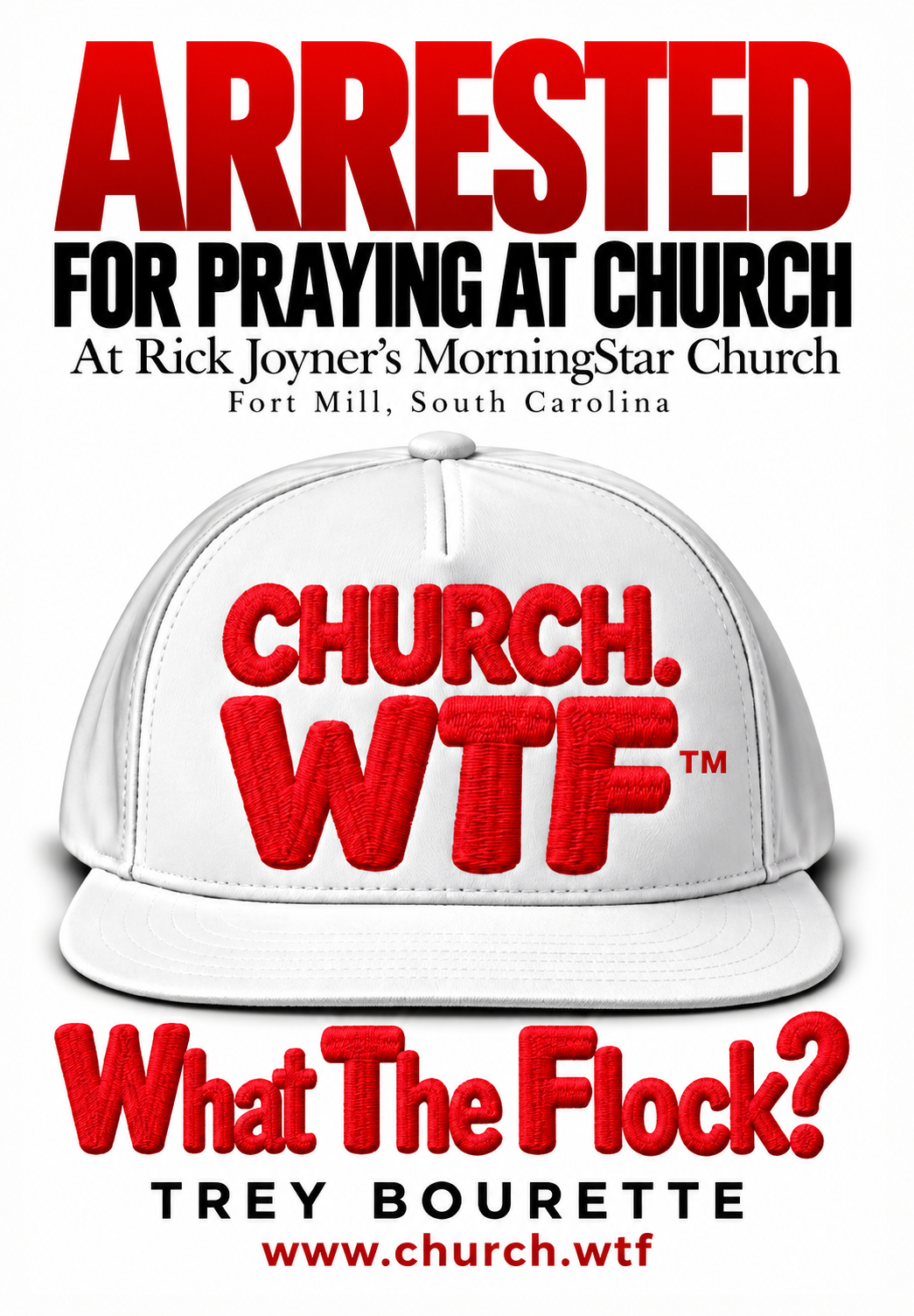
Church. WTF? What The Flock?
So yes church. WTF? What The Flock? That's not some hidden curse word. It has meaning. It asks a very profound question about what the church has become and must become. Jesus is What The Flock must look like, love like, and live like. It's not just a funny saying. It's a real question. And I'm asking the whole Church. What have we become? What have we become when a peaceful 62-year-old man, who had never been arrested in his entire life, ends up being arrested for the first time for praying at a church? At the very church he believed God had called him to love.
But there's something I want you to understand before we go any further. This book isn't about getting even. I didn't write it because I was angry with MorningStar. I wrote it because I cared about MorningStar. And I still care. Because MorningStar isn't the only church struggling with these things.
How Can We Claim to Represent Jesus If We No Longer Look Like Him?
The problems we're going to explore in this book are much bigger than one ministry, one pastor, one building, or one arrest. They're problems that affect all of us. And if we're going to be honest about the condition of the Church, we have to be willing to ask some uncomfortable questions. Questions about leadership. Questions about authority. Questions about power. Questions about what happens when protecting an institution becomes more important than loving the people Jesus came to develop, to love, to save.
And perhaps the most uncomfortable question of all: How can we claim to represent Jesus if we no longer look like Him? That's the question behind everything. Because Jesus didn't tell us the world would recognize His disciples by the size of their buildings, the influence of their leaders, the sophistication of their theology, or the success of their ministries. He said they would recognize us by our love for one another. And somewhere along the way, I think we've made things much more complicated than that.
So, yes, I was arrested for praying at church. And yes, there's a story behind that arrest that deserves to be told. But I don't want the arrest to become more important than the reason I went there in the first place. Love. That's what this book is about.
That is the church's real mission. To fill the earth with faith, hope, and love... one person at a time. To look like, live like, and love like Jesus. That's what What The Flock is supposed be. We are His body, right? The expression of Him. The fullness of Him. His representatives here on earth. That's what I believed MorningStar needed. And that's what I believe the whole Church needs. All of us. We need to look, love, and live like Jesus again.
So if you came here because the cover caught your attention, I'm glad you're here. But I hope you'll stay for something much more important than the story of an innocent 62-year-old man getting arrested for praying at church. I hope you'll stay long enough to ask yourself a question. What would the Church look like if we actually loved one another the way Jesus told us to? Because I believe the answer to that question could change everything about everything. And perhaps that's why this book needed to be written. Even before I was arrested.
But I can't help wondering about something. Would Jesus have been arrested there on that Sunday morning? The same Jesus who overturned the tables of the money changers and drove them out of the temple violently? The same Jesus who declared that His Father's house was supposed to be a house of prayer, not a place of business. Would He have been welcomed at MorningStar? Or would He have been considered a problem?
And here's another question. If I had been a million-dollar donor, would I have been arrested? Would my presence have been treated differently? Would my prayers have been more welcome? And what about the apostle Paul? Would Paul have been arrested for insisting on his right to pray? At church? A church that had invited him? "I told them that it is not the Roman custom to hand over anyone before they have faced their accusers and have had an opportunity to defend themselves against the charges." Acts 25:16
The Church belongs to Jesus. And if we've built something where money matters more than people, where authority matters more than love, and where protecting an institution matters more than representing Christ, then we have a much bigger problem than one man being arrested for praying. We have a problem with what we've become.
So if what I am saying to you is true, and I am telling you it is, then the fact remains... I went to MorningStar to pray. I left in handcuffs. So yes, we have a problem! That's why we need to talk about this.
Please Consider 5 Observations
I had spent months praying for this church. I had written an entire book because I believed God wanted to help heal its wounds. The following morning, I was arrested outside that same building I was praying in the previous morning. If you're a prayer warrior, you know how demonic that sounds. But something happened before those handcuffs went on that I want to tell you about.
I believed the truth deserved a conversation. These security guards did not represent my relationship with MorningStar. And the allegations were false. I believed that what was happening raised a question much bigger than my personal circumstances. What does following Jesus require of us when the people representing Him or His church don't appear to be acting like Jesus? Please consider the following six questions.
1. WHAT HAPPENED TO THE HOUSE OF PRAYER?
"My house will be called a house of prayer." Matthew 21:13
Jesus wasn't making a suggestion. He was declaring what His Father's house was supposed to be. A house of prayer. I came to MorningStar to pray. I wasn't organizing a protest. I wasn't trying to disrupt a service. I wasn't demanding a position or a platform. I believed God had sent me to love and encourage a wounded church. And somehow, I ended up in handcuffs. Think about that. I went to pray. I left in handcuffs. What happens when someone comes to the house of God to pray and finds himself unwelcome? What happens when the people responsible for protecting the house begin to lose sight of what the house exists for? And perhaps most importantly: Who is supposed to protect prayer in the house of prayer?
2. JESUS CAST THEM OUT. I WAS CAST OUT.
When Jesus entered the temple, He didn't simply accept what He found. He confronted it. He overturned tables. He drove people out. And He declared that His Father's house was supposed to be a house of prayer. What happened next? The religious authorities began looking for a way to kill Him. Read Mark 11:15 - 18. The people responsible for the religious institution were confronted by the very One the institution was supposed to represent. And they wanted Him gone.
Now consider the irony. Jesus cast people out while defending the house of prayer. I was cast out after coming to pray. I'm not suggesting my circumstances were identical to His. But I am asking whether we recognize the pattern. What happens when religious institutions become so concerned with protecting themselves that they resist the very things Jesus came to establish? What happens when the people who challenge something wrong are treated as the problem? And here's the question that troubles me: If Jesus walked into our churches today and challenged what He found, would we recognize Him - or would we ask security to handcuff Him, arrest Him, remove Him?
3. WOULD IT HAVE BEEN RIGHT FOR ME TO REMAIN SILENT?
This question is personal. Because I had a decision to make. When I was confronted with statements that were completely false, I initially left. I could have kept driving. I could have started my eight hour ride home. I could have accepted what had happened without asking another question. But would that have been the right thing to do?
I believed a misunderstanding had occurred. I believed the truth could resolve it. And I believed someone exercising spiritual authority should be willing to hear an explanation. So I returned. Not to fight. Not to disrupt. To ask for a conversation with a pastor. I was willing to leave if the pastors wanted me to leave. But I wanted them to hear the truth. And I wanted to hear the truth from them.
And this is where the question becomes your question as much as it is mine. When something happens in the Church that you believe contradicts the character of Jesus, what are you supposed to do? What are you willing to do? Are you willing to get arrested? Kicked out of church? Rebuked as a heretic? Called a rebel? Called demon-possessed, like Jesus was? Or violently arrested like me? Or are you going to remain silent? Walk away? Assume that someone who possesses any kind of authority is automatically right? That they are God's will for you? To be obeyed at all costs?
We need to be prepared for this question. It just might come your way. Especially today. Jesus taught us to pursue truth, reconciliation, and love. Sometimes love means yielding. Sometimes love means confronting. And sometimes the most uncomfortable thing a Christian can do is respectfully ask a religious leader to explain a decision. So, would you have returned? I don't ask that because I believe every Christian must make the same decision I made. I ask because I want you to consider what your own conscience would require. When does walking away preserve peace - and when does it allow something wrong to continue unchallenged? When does walking away look completely unlike Jesus?
4. WE MUST OBEY GOD RATHER THAN HUMAN BEINGS.
Before you decide whether I should have returned to MorningStar, I want you to read something. Acts chapter 5. The apostles were preaching Jesus in Jerusalem. The religious authorities didn't like what was happening. So they arrested them and put them in jail. But something extraordinary happened that night. An angel of the Lord opened the prison doors and brought them out. And what did the angel tell them to do? Go back. Not to another city. Not to another congregation. Not somewhere they would be more welcome. Back to the temple courts. The very place where the religious authorities had been trying to silence them. And the angel instructed them to continue proclaiming the message of life.
So what did the apostles do? Run? No! They went back. Early the next morning, they entered the temple courts and began teaching again. Think about that. They had been arrested. They had been imprisoned. And they returned. Then the religious authorities discovered what had happened. The prison was locked. The guards were standing at the doors. But the prisoners were gone. And where were they? Back in the temple. Teaching. So the authorities brought them before the Sanhedrin. And the high priest confronted them. Hadn't they been given strict orders not to teach in Jesus' name? Why had they disobeyed? Peter answered with one of the most important declarations in the New Testament: "We must obey God rather than human beings!" Acts 5:29
Now stop and consider something. Who was trying to silence the apostles? Not atheists. Not people who rejected religion. Not enemies of the Scriptures. Religious leaders. The very people who believed they were responsible for protecting God's house, God's people, and God's authority. And yet they were standing against the work of God without knowing it. The apostles understood something that Christians must never forget. All authority is not necessarily God's authority. And obedience to hired out leadership is not necessarily obedience to Jesus.
But there's something else in this chapter I don't want you to miss. After Peter and the apostles refused to remain silent, the religious authorities became furious. They wanted to kill them. Then Gamaliel, a respected teacher of the law, stood up and warned them. If this movement was merely human, it would eventually fail. But if it was from God, they would not be able to stop it. And worse, they might discover that they were fighting against God Himself. Read Acts 5:38 - 39.
What if the people who believe they are protecting God's institution are actually opposing something God is doing? That is a question every church should be willing to ask. Including MorningStar. Including every church I've ever attended. Including every church I've ever pastored. And including the Church as a whole.
Now let me bring this back to my experience. I believed God had sent me to MorningStar. I had spent months praying for the church. Investing my heart. My emotions. My time. I had written a prophetic book intended to encourage its healing. And I had driven a long way to be there. So when I encountered statements about me that were completely false, I wanted an opportunity to correct them. I left. Then I returned. Not because I wanted to fight authority, but because I believed the truth deserved to be heard. I wanted to speak with a pastor. I wanted a conversation. And I believed walking away without attempting to resolve what had happened would leave something important unaddressed.
Walking was wrong for me! And I felt deeply I must obey God and not man. Was my situation identical to Acts 5? Of course not. But the question of conscience is unmistakable. When authority tells you to go one way, but you believe following God requires something different, what do you do? Do you simply comply? Do you assume the authorities must be right? Or do you examine their instructions against the character and teachings of Jesus? And here's the question that makes Acts 5 so relevant to CHURCH.WTF: What if the greatest danger to the Church isn't people who refuse to obey religious leaders, but religious leaders who have forgotten whom they are supposed to obey?
The apostles had their reasons for believing God wanted them to return. I had mine. The question isn't whether our circumstances were identical. The question is whether we were faithful to what we believed God was asking of us.
WE MUST OBEY GOD RATHER THAN HUMAN BEINGS. That includes human beings who "secure" churches.
5. WHAT THE FLOCK?
Now we arrive at the question behind the title of this book. CHURCH.WTF What The Flock? It's intentionally provocative. Because I believe the Church needs to be provoked into asking some very important yet simple questions with simple answers. Jesus is What The Flock must look like, love like, and live like. It's that simple! Represent Jesus! Not look like our favorite pastor. Not our denomination. Not our traditions. Not our institutions. Look like Jesus. And if Jesus is our standard, then everything we do in His name must be examined in the light of His life.